Omnia Stack
Omnia provides two distinct deployment models tailored to different workload requirements: the Kubernetes Stack for containerized applications and the Slurm Stack for high-performance computing (HPC) workloads. These stacks can be deployed independently or in a converged configuration where both Kubernetes and Slurm coexist on the same infrastructure, enabling organizations to support diverse workload types within a single management framework.
The following diagrams illustrate the architectural layers and component relationships for each deployment model.
Omnia Kubernetes Stack
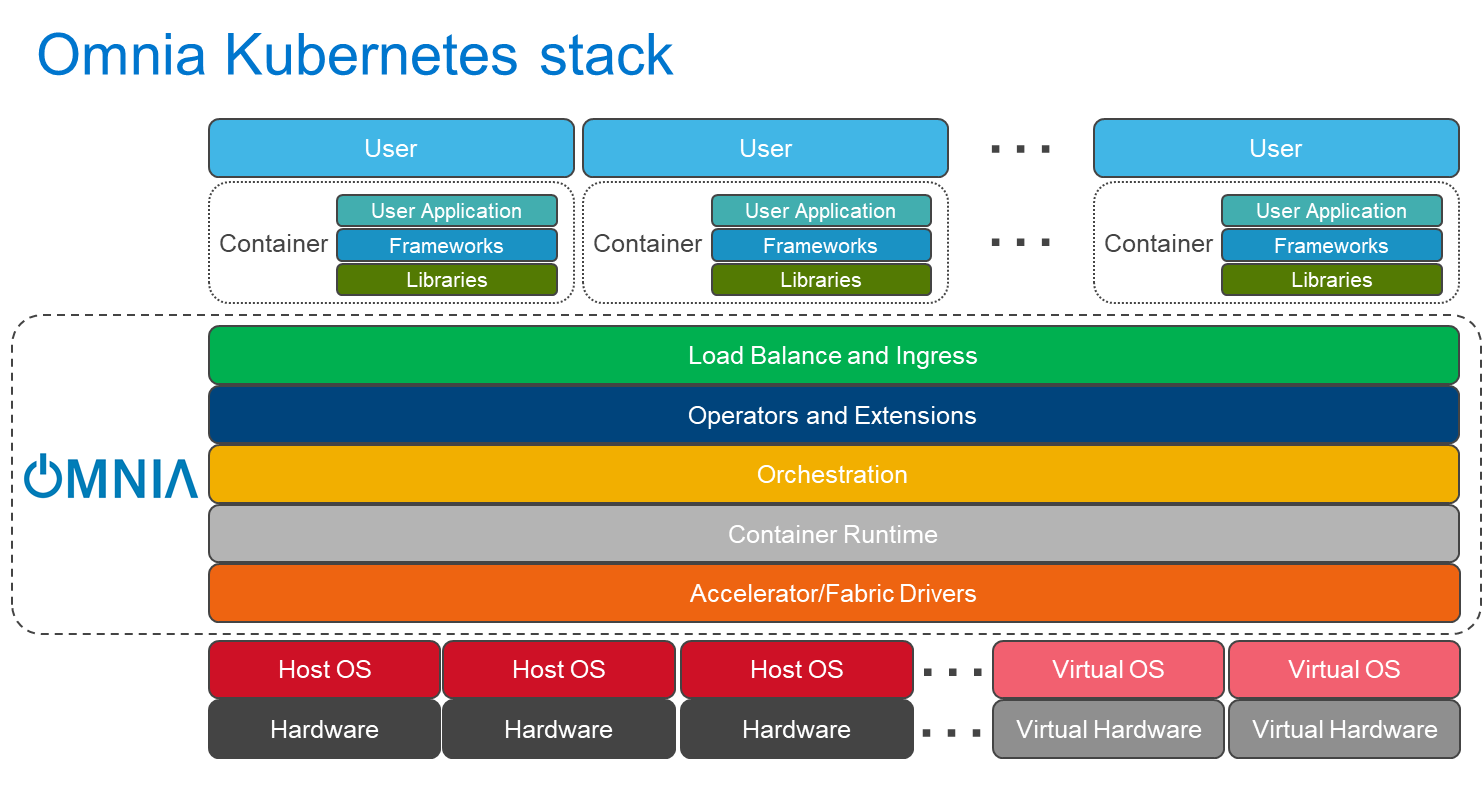
The Kubernetes stack provides a complete container orchestration platform for deploying and managing containerized applications. Key components include:
Infrastructure Layer: Bare-metal or virtualized Dell PowerEdge servers with iDRAC management
Operating System: RHEL-based provisioning with cloud-init configuration
Container Runtime: Containerd for running containerized workloads
Orchestration: Kubernetes cluster with control plane and worker nodes
Networking: Calico CNI for pod networking, MetalLB for load balancing
Storage: CSI drivers for PowerScale and other storage backends
Monitoring and Telemetry: VictoriaMetrics for metrics collection, Kafka for telemetry data streaming
Application Layer: User-deployed containerized workloads
Omnia Slurm Stack
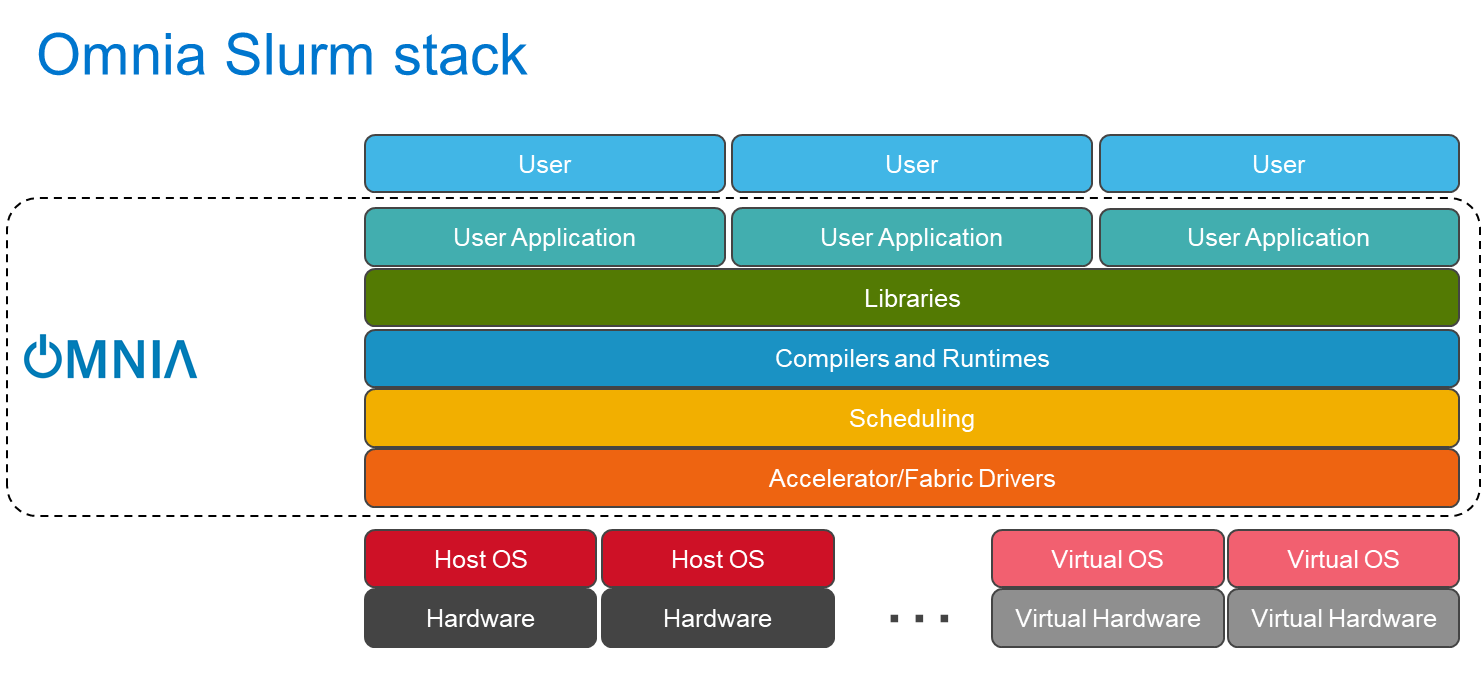
The Slurm stack provides a workload manager optimized for HPC and batch job scheduling. Key components include:
Infrastructure Layer: Bare-metal or virtualized Dell PowerEdge servers with iDRAC management
Operating System: RHEL-based provisioning with cloud-init configuration
Resource Management: Slurm Workload Manager with control and compute nodes
Networking: InfiniBand for high-performance interconnects, Ethernet for management
Storage: NFS mounts for shared filesystem access
GPU Support: NVIDIA GPU provisioning with CUDA Toolkit and DCGM for GPU-enabled nodes
Monitoring and Telemetry: LDMS and other HPC-specific monitoring tools
Application Layer: Batch jobs, MPI workloads, and other HPC applications
Virtual Deployment Considerations
The diagrams show Virtual OS and Virtual Hardware blocks to represent scenarios where Omnia can be deployed on virtualized infrastructure. However, Omnia is primarily designed and tested for bare-metal deployments to ensure optimal performance for both Kubernetes and Slurm workloads. Virtual deployments may be supported for specific test or development scenarios, but production environments should use bare-metal hardware to avoid performance limitations and ensure full compatibility with all Omnia features.
If you have any feedback about Omnia documentation, please reach out at omnia.readme@dell.com.